Photo calorie counting: accurate, not precise
A photo calorie counting app gets food right 68-86% of the time, portions as low as 39%. What the research shows, where the error lives, and what we measured.
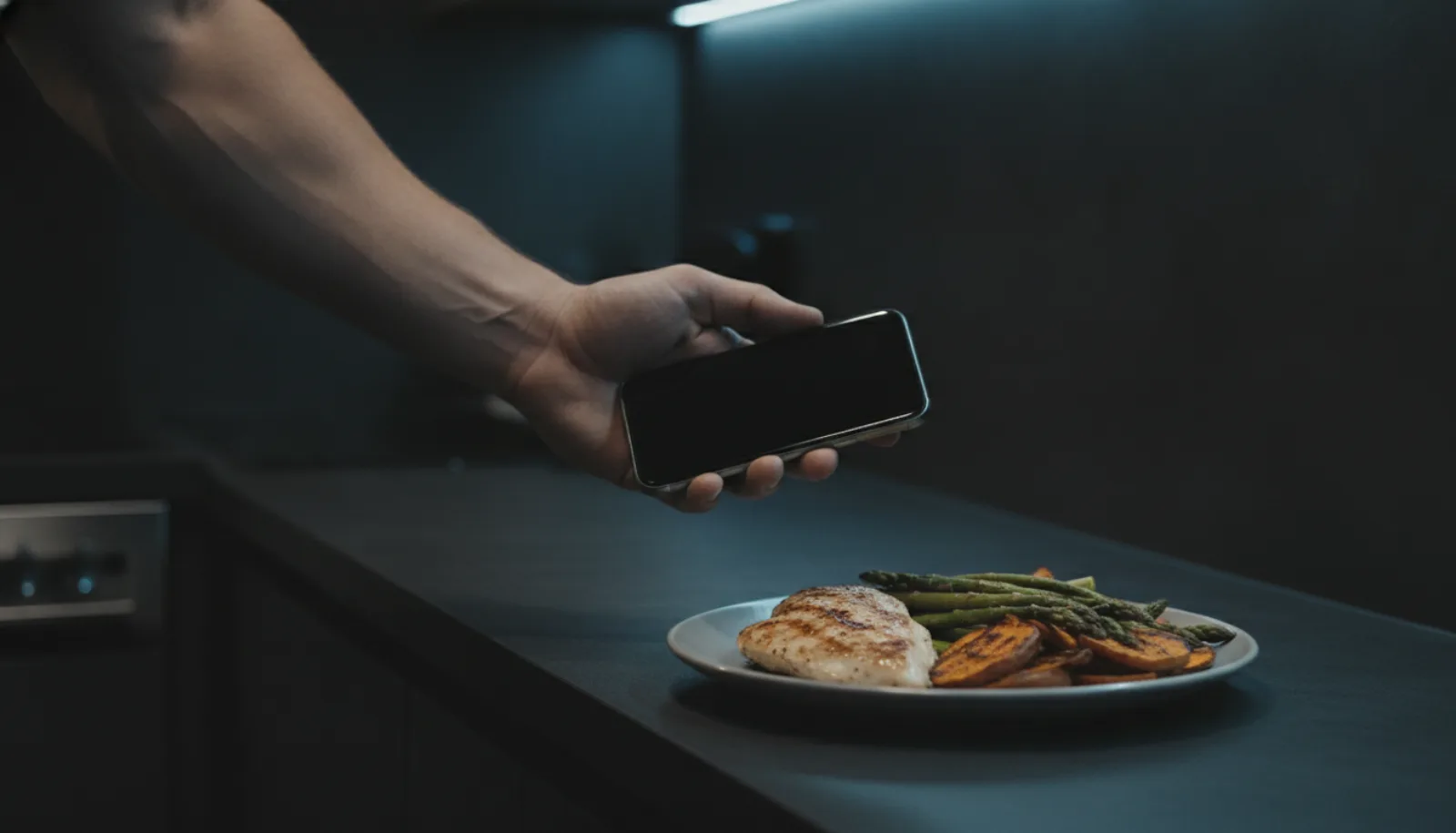
A photo calorie counting app is accurate within a range, not to an exact number: real-world testing puts food identification around 68 to 86 percent and portion-size estimation as low as 39 percent, with errors compounding as the two combine. Manual logging is not the precise alternative it looks like either, typically underestimating intake by 20 to 50 percent from missed ingredients and rough portions. No independent research has named one most-accurate photo calorie app, and a source quoting an exact percentage for itself is a marketing signal more than a verified result. We measured our own instead. On photos logged in GreekBody, moving the sizing to a vision model built for it cut the gram error from roughly 70 to 100 percent to 25 to 35 percent. Better. Still an estimate, and logged as one.
Why no single accuracy number is the right answer
Search for the most accurate photo calorie counting app and nearly every page answers with a confident percentage: 90 percent, 95 percent, sometimes a decimal point added for effect. None of it is independently verified. No outside research has crowned one most-accurate app, and a source quoting a suspiciously exact figure, such as plus or minus 1.9 percent, is treating marketing copy as a lab result.
That gap already has a name in the industry. Fitia’s own page on this exact question runs a section called “Lab Accuracy vs. Real-World Accuracy: The Gap You Need to Know”.
That gap is why this article gives a range instead of a verdict. A photo calorie counter app can be useful without being precise, and those are two different claims. What follows breaks down where the estimate actually loses ground, what manual logging gets wrong in the opposite direction, and what GreekBody promises instead of a number it cannot back up.
Where photo estimates actually lose accuracy
A photo calorie estimate is really two guesses stacked on top of each other: what the food is, and how much of it there is. Recent evaluations put real-world food identification at roughly 68 to 86 percent, while portion-size estimation, the harder problem, drops as low as 39 percent. Because the two steps run in sequence, a small miss on the first compounds into a larger miss on the second, and the final calorie number carries both errors at once.
The specific blind spot shows up in the same place every time: cooking oil, butter, dressing, sauce, and anything sitting underneath another ingredient. None of it is visible to a camera, and on a plate built around fat loss, that is exactly the category of calories dense enough to matter.
The error is height, not footprint
We tested this on real plates, weighed on a kitchen scale first, then photographed and sized by six vision models, ours among them. Every one of them read the plate’s footprint well: how much of the plate the food covered. Every one guessed the depth wrong, and the grams came back 1.5 to 4 times too high. Putting a plate of known size in the frame as a ruler did not help, because the ruler measures the footprint, which was already right.
Behind the height sits density. Two foods of the same shape and size can differ threefold in grams: a mound of leafy salad and a mound of rice look alike to a camera and weigh nothing alike. No photo sees that. It has to be known about the food, not read from the picture.
One more failure, and it is a prompt, not a camera. Early on, a salad came back at 1,035 kcal. The model had been told to estimate the high end of the range, and it did. The fix is to log the middle of the range and let the man correct it. That is what an honest estimate does.
It is easy to assume a person could just eyeball the photo and do better. The research says otherwise. In a crowdsourcing study of over 2,000 people estimating calories from food photos against a known true value, the average participant got 5 out of 20 guesses within 20 percent of the real number, matching the accuracy of an expert annotator working alone; a pooled group of just 10 people beat both of them. Photo-based estimation, human or automated, runs into the same limits: what is visible in the frame, and what is not.
Manual logging is not a precise baseline either
It is tempting to treat typing a meal into a food diary as the accurate option and a photo as the approximate one. The research does not support that split. Manual logging carries its own underestimation, typically 20 to 50 percent below actual intake, driven by rough portion guesses and ingredients that never make it into the entry at all. A bowl of pasta with a splash of oil and a spoon of parmesan added off the record produces the same blind spot a photo has, just introduced by hand instead of by a camera.
The better question is not which method hits the true number, since neither reliably does. It is which method someone will actually keep using once the week gets busy. A method that is somewhat off but used every day beats a method that is occasionally exact and abandoned after a few days. That is the standard the rest of this comparison uses: not which app claims the tightest number, but what each one actually gets right and where it predictably misses.
How MyFitnessPal, Fitia and Cal AI answer the same question
None of the apps competing for this question answer it with an independent number. MyFitnessPal’s own Meal Scan support page describes the feature as combining photo recognition with a large food database, letting you correct the results it suggests. MyFitnessPal versus an AI coach app covers the rest of that comparison in more depth. A second AI engine’s answer to this question cites Healthline’s independent review, which puts it plainly: no calorie app is 100 percent accurate once portion size and hidden ingredients enter the picture.
Fitia’s own research review takes a different approach: instead of a number for its own app, it names the lab-versus-real-world gap directly. That gap shows up in independent research too: a peer-reviewed study separately compares manual food logging against AI food-image recognition using actual food records, the kind of outside evidence this question needs more of.
Cal AI is the outlier: one source rates it at 90 to 95 percent accuracy on common foods, but the figure is self-reported testing, not an outside study, and it earns the same skepticism as any other single-app percentage. The pattern across every app answering this question matches where this article started: a specific number for your own product is easy to publish and hard to verify from the outside.
What GreekBody’s photo calorie estimate actually promises
GreekBody’s Photo calories feature, available on Pro, starts from the same point as every app in this comparison: a photo of the plate. What happens next is split in two. A vision model whose only job is sizing reads the plate, item by item, and returns a range for each. The coach is kept out of the sizing; it logs what the reader found, at the middle of each range, and marks every row as an estimate.
That split is where the measured gain came from. With the coach sizing the food, the gram error on logged photos ran at roughly 70 to 100 percent. With the dedicated reader, 25 to 35 percent. It is the honest number today, and it is still an error you should expect on every plate, largest on anything piled high or dressed in oil.
A range instead of one number gives the identification and portion errors somewhere to live instead of hiding inside a false decimal point. Each item is its own row, so you can catch the blind spot no camera sees: the oil in the pan, the dressing on the side, the sauce mixed through the dish. Fix the row, not the meal. If you weighed something, mark it “Weighed on a scale” and the gram is stored as measured, never estimated again. GreekBody’s Body tab applies the same range-based approach to estimating body fat at home without calipers.
What GreekBody will not do is sell 25 to 35 percent as accuracy. It is what we measured on our own logged photos, not a score for every plate, and not an outside study. That is a smaller promise than “90 to 95 percent accurate,” and, based on everything above, a more defensible one. An itemised, editable estimate beats a confident number that cannot be checked.
Choosing a logging method for the meal in front of you
None of this makes photo logging the wrong tool. It makes it a tool suited to particular plates. A single visible meal, cooked simply and served on one plate, avoids the blind spot that trips up photo estimates: there is no hidden oil, sauce, or buried ingredient for the camera to miss.
The moment oil, sauce, or a hidden ingredient enters the picture, treat the estimate as a starting point and not a finished number. For a packaged item with a printed label, reading the barcode is simpler than estimating from a photo, since the label already states the number. For a meal that is not visible at all, a protein shake mixed earlier, or leftovers eaten from a container, speaking it in or logging it by hand will get closer than a photo of an empty plate ever could. When there is no scale either, track calories without weighing food covers hand portions and household measures for exactly that case.
If a scale is in the kitchen and the food is going on the plate anyway, weigh it. A photo replaces guessing. It does not replace the scale. Once the meal is logged, what to eat tonight for protein shows how to fill the grams still left in the day.
Match the method to the meal, and treat every method’s number as an estimate worth checking, not a final answer.
There is no single most-accurate photo calorie counting app, and any source quoting one exact number for itself is asking for more trust than the research supports. Real-world testing puts photo estimation somewhere in a range, manual logging misses in its own direction, and every named app in this comparison, GreekBody included, works inside those same limits. What separates a useful tool from an overconfident one is not a bigger percentage; it is whether it says where its number is weak and lets you fix what it got wrong. The weak spot is height and density, not what the food is. That is the promise GreekBody’s Photo calories feature makes: a measured error of 25 to 35 percent on logged photos, the middle of each range, every row correctable, and a weighed gram kept as truth.
Frequently asked questions
Does GreekBody's photo calorie estimate require Pro?
Yes, GreekBody's Photo calories tool sits behind Pro.
What happens if the photo estimate gets a food wrong?
Each item is logged at the middle of its range and marked as an estimate. Correct the one row that is wrong, in the meal sheet or in a sentence to the coach. A row you weighed and mark as weighed is stored as measured and never estimated again.
Is a barcode scan more accurate than a photo for calories?
On anything with a label, yes. A barcode reads the number already printed on the package, while a photo still has to identify the food and its portion from an image, the two steps where photo estimation loses the most ground.
Does weighing food on a scale beat a photo estimate?
Yes. A weighed gram beats every photo estimate, ours included. The catch is doing it every time, which most men stop doing within weeks. A photo replaces guessing, not the scale: weigh what you can, photograph the rest.