MyFitnessPal vs an AI coach app for men
MyFitnessPal vs AI coach app, compared on the same criteria: the food database, who writes the training, how each one adapts, and what is free.
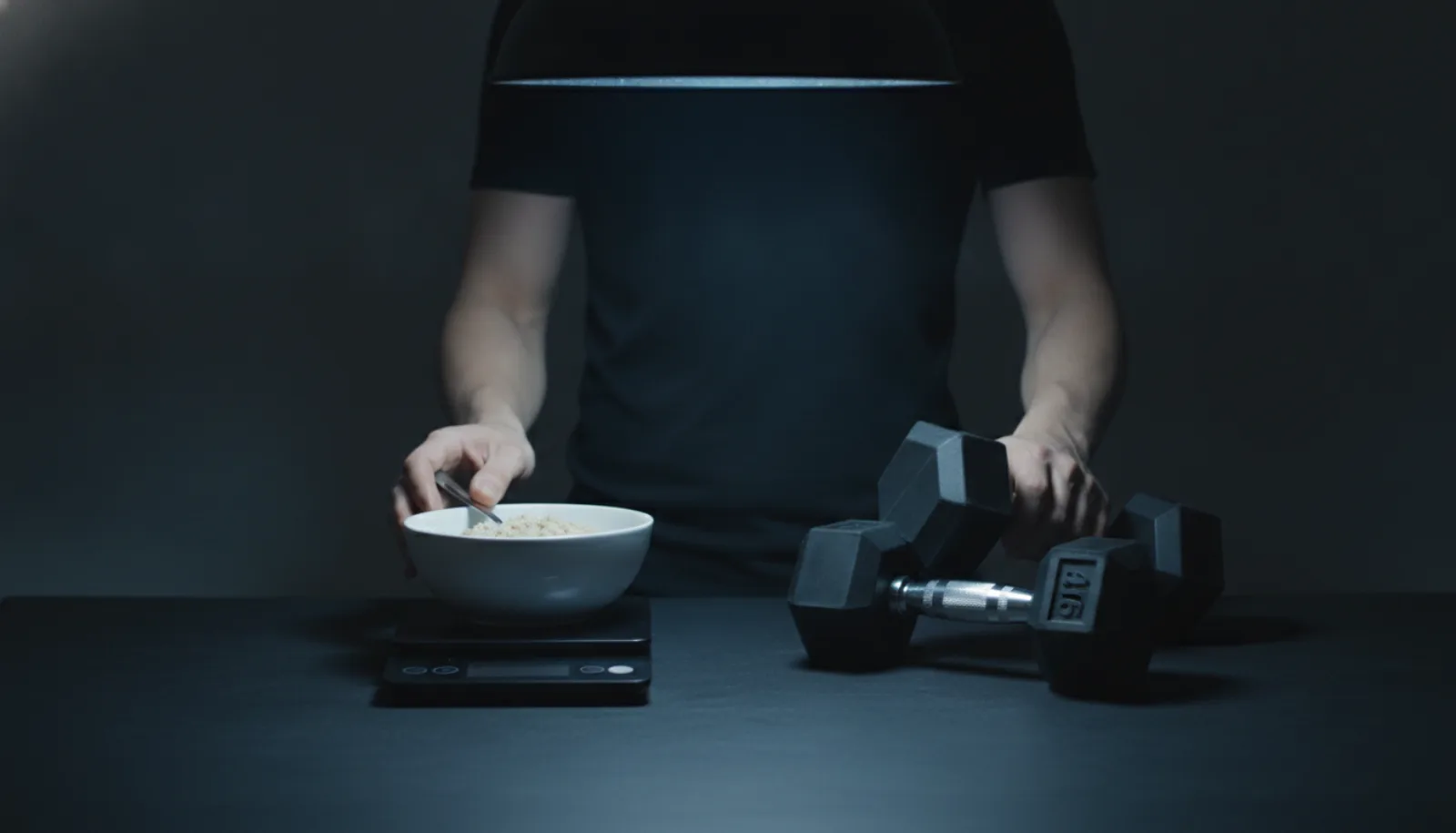
MyFitnessPal records what you ate. An AI coach app decides what you do next, on the training side as well as the food side, and the distance between those two sentences is the whole comparison. If your program is already written and you want the number off the label instead of an estimate of it, MyFitnessPal is the better tool, and its database is the reason. If the question that stops you is what to lift tonight and what you can still eat at nine o’clock, a log will not answer it: MyFitnessPal’s own AI assistant answers nutrition questions and suggests food swaps, and it does not design exercise routines. What follows is both apps on the same criteria, including the two that MyFitnessPal wins.
How a tracker and a coach split the work
The version of this comparison you usually land on is narrated by the incumbent. ChatGPT’s answer to it cites support.myfitnesspal.com and nothing else. Google’s AI Overview for the same question opens with a link to MyFitnessPal’s Nutrition Coach announcement. So it is worth being plain about what each kind of app is built to hold.
A tracker holds a record. You pick the meal, you pick the session, the app stores both and does the arithmetic. MyFitnessPal’s AI layer runs as a chat tab that reads your real food diary, calorie targets and macro habits, then suggests ingredient swaps or restaurant menu choices. That is a good assistant sitting on top of a good log, and it waits to be asked.
A coach holds the plan. It writes the training days, sets the weights, and moves both when your week moves. Six criteria separate them.
| Criterion | MyFitnessPal | GreekBody |
|---|---|---|
| Food entry | 20.5M foods, restaurant menu items, barcode scan | a spoken sentence, your usual meal proposed at its hour, 12,809 USDA foods, saved foods and recipes |
| Who writes the training | you do; members track exercise | the app generates the days, on the weekdays you pick, and the working weights |
| Progression | not written for you | double progression, tempered by how you turned up |
| A week that goes wrong | the numbers move | a today-only override, base program intact |
| The AI layer | a chat tab over the food diary | a coach you talk to, unlimited on Pro |
| Where it runs | 40+ connected apps and fitness devices | iPhone only |
The food database, where MyFitnessPal wins
Give MyFitnessPal this one outright. Its own homepage claims 20.5 million foods and the ability to track menu items from popular restaurant brands, and says barcode scanning gives fast, accurate nutrition info on packaged foods. For a man whose diet runs on packaged food and restaurant meals, that is a real advantage, and no AI-first app has an answer to it. Google’s summary of the category names the opposite failure directly: photo-based AI estimates struggle with hidden cooking oils, sauces and complex mixed dishes, which produces accuracy errors.
One qualification, from MyFitnessPal’s own pages. Easy barcode scanning, meal photo logging and voice logging are listed as features of the paid tiers, so the fastest ways into that database are behind the subscription. If the tracker you are weighing is built around weekly calorie targets instead, GreekBody vs MacroFactor for fat loss makes that comparison.
What speech buys you is entry speed, and it is a different thing from precision. Say “3 eggs, 55 g bread, 10 g butter” into GreekBody and it is logged, and the meal you usually eat at that hour is proposed before you say anything. The hold-to-talk mic sits on the coach’s composer: talk to Achilles and he logs the food or the set. It is never gated or metered. Photo calorie counting stays an estimate: a vision model sizes the plate, the gram error on logged photos runs at 25 to 35 percent, and a gram you weighed is kept as measured. We have written the longer case for logging food by voice elsewhere. If label-level exactness is your first criterion, stay where you are.
Who decides what you lift on Tuesday
Here MyFitnessPal states its own position clearly. All members can track their weight goals, exercise, and water intake. Track. The exercise entry is a record of a session you already chose, priced into a calorie budget after the fact. The AI Overview answering this query puts the limit in one line: the built-in AI assistant answers nutrition questions and suggests food swaps based on what you already logged, but it does not design full exercise routines.
Its newest AI layer did not change that. In MyFitnessPal’s own release wording, AI Coach turns daily food logging into personalized, actionable nutrition coaching powered by each user’s own logged meals, goals and habits, and the new Plan tab offers recipes, saved meals and suggestions matched to your goal. Read the nouns. The plan under discussion is dinner.
GreekBody starts at the other end of the day. It generates the workout days, Day A, B and C to start, puts them on the weekdays you go, sets the working weights, and progresses them with double progression tempered by soreness, sleep, energy and pain, a different approach from the best apps for progressive overload tracking that leave that decision to you, and it substitutes a movement when something feels weird. If the rep scheme behind that is new to you, we have a short piece on double progression. The practical difference on a Tuesday: one app has an empty exercise field, the other has a session with weights in it. For the wider field of apps that do this, see our roundup of AI workout apps for men, and for the training-first end of it, Fitbod vs Caliber.
What happens when the week goes sideways
Criteria are easy to compare on a good week. Test them on a bad one: four hours of sleep, a shoulder that complains on the second set, two sessions missed.
A tracker’s response is arithmetic. The diary shows fewer calories burned and a flatter trend line, and the decision about what to do on Thursday stays with you, which is exactly where it was on Monday.
A coach’s response is a changed session. GreekBody asks for energy and soreness before you train and produces a today-only override, leaving the base program intact, so a bad Tuesday costs you a Tuesday and not the block. Movements get substituted when something feels weird. MyFitnessPal’s nearest equivalent runs on the food side, where the Plan tab gives you an idea for right now. That is a real answer to a real problem. It is a different problem.
The evening question, and who answers it
Nine o’clock, most of the day logged, and the question is how much steak fits in what is left. This is the moment where a log and a coach diverge, and it is fair to say MyFitnessPal has closed part of the gap: its AI Coach reads the actual food diary, calorie targets and macro habits and comes back with ingredient swaps or restaurant menu choices. Asked a nutrition question, it answers from your data instead of from generic advice.
GreekBody answers the same question from the numbers you have left: how much steak can I eat tonight is a question the app takes. You ask it by holding the mic, because the app would rather you did not type. Ask it to structure the rest of the day and it plans dinner around what is missing, protein first, then the fibre or fat gap, read from what you logged rather than guessed. The protein side of that arithmetic is its own topic, and we have covered how much protein to eat. The gap is no longer about whether an app can answer a food question. It is about whether the thing answering also owns your training.
What is free, what is paid, and what runs on your phone
Both apps put a wall somewhere, and the walls sit in different places. MyFitnessPal’s Premium page lists customized weekly meal plans, faster logging and deeper insights, with easy barcode scanning, Meal Scan photo logging and voice logging among the paid features, and the Meal Planner under Premium+. The food database is open to everyone; the fast doors into it are not.
GreekBody inverts the wall. Logging is free forever, workouts and food both, along with the hold-to-talk mic, the program and progression engine, adaptive days, trends, your usual meals, saved foods and recipes, plus a starter allowance of coach messages. Unlimited coach conversations, photo calorie estimation, the weekly review and Connect, which puts Achilles inside your own ChatGPT or Claude, are the paid part. Log free, coach paid. Neither price belongs in this post: MyFitnessPal’s tiers are its own to quote, and GreekBody’s number is set in App Store Connect and is not public yet.
Then the criterion that settles it for a lot of readers. MyFitnessPal connects to more than 40 apps and fitness devices. GreekBody is iPhone only, with no Android app and no web app. On an Android phone this comparison is over before the criteria start.
Which one fits which man
Stay with MyFitnessPal if your training is already settled and the food log is the only job you need done, or if you eat mostly packaged and restaurant food and want label-level numbers. If you are not on an iPhone, stay there too: GreekBody is iPhone only. Its AI Coach makes the food half smarter, and for a man who already knows what he is lifting, that may be the whole requirement.
Move to a coach app if the thing that actually stalls you is deciding what to do next, and if you would rather say what you ate than search for it. That is the case GreekBody is built for: it generates the days, sets the working weights and progresses them, so the deciding stops being yours.
Running both is allowed, and for a while it is common. The question is which one you open first.
The short version
MyFitnessPal is a database-first tracker with a nutrition assistant on top, and on food entry breadth and connected devices it wins. It does not write your training, by its own account and Google’s. An AI coach app takes the decision instead of recording it: the days, the working weights, the progression, and the evening question answered from the numbers you have left. Pick by which half of the job is unfinished. GreekBody is iPhone only. Download it on the App Store.
Frequently asked questions
Is there any app better than MyFitnessPal?
Better at what. On food entry, MyFitnessPal's own homepage claims 20.5 million foods, restaurant menu items and barcode scanning. On training it stops early: its built-in AI assistant answers nutrition questions and suggests food swaps, and it does not design full exercise routines. Decide which of the two jobs you are actually trying to fill.
Does MyFitnessPal build workout plans?
No. Its own pages describe members tracking their weight goals, exercise and water intake, which is logging a session you chose yourself. Google's AI Overview for this question says the built-in AI assistant does not design full exercise routines. MyFitnessPal describes AI Coach as nutrition coaching powered by each user's own logged meals, goals and habits.
What is more accurate, a photo estimate or a barcode scan?
The scan, on anything with a label. Photo-based AI estimates struggle with hidden cooking oils, sauces and complex mixed dishes, and that produces accuracy errors. GreekBody measured its own: 25 to 35 percent gram error on logged photos, logged at the middle of each range and marked as an estimate. Speaking the meal is the faster route when no label exists.
Is MyFitnessPal's AI Coach the same as an AI personal trainer?
No. It runs as a chat tab that reads your food diary, calorie targets and macro habits, then suggests ingredient swaps or restaurant menu choices. That is nutrition help grounded in your own log. A trainer writes the sessions and the working weights and progresses them, which is the half MyFitnessPal leaves to you.
Can one app handle both the workouts and the food?
That is the whole premise of the AI coach category, and it is what GreekBody is built as: the program and the working weights on one side, spoken food logging and the remaining-numbers question on the other, in one conversation. MyFitnessPal covers the food half deeply and the training half as a log. Coverage of both is the trade against a smaller food database.