How to log food by voice instead of typing
Speak the item, the portion and the preparation and a voice food logging app files the whole meal in one sentence. How to say it, and how to fix a wrong parse.
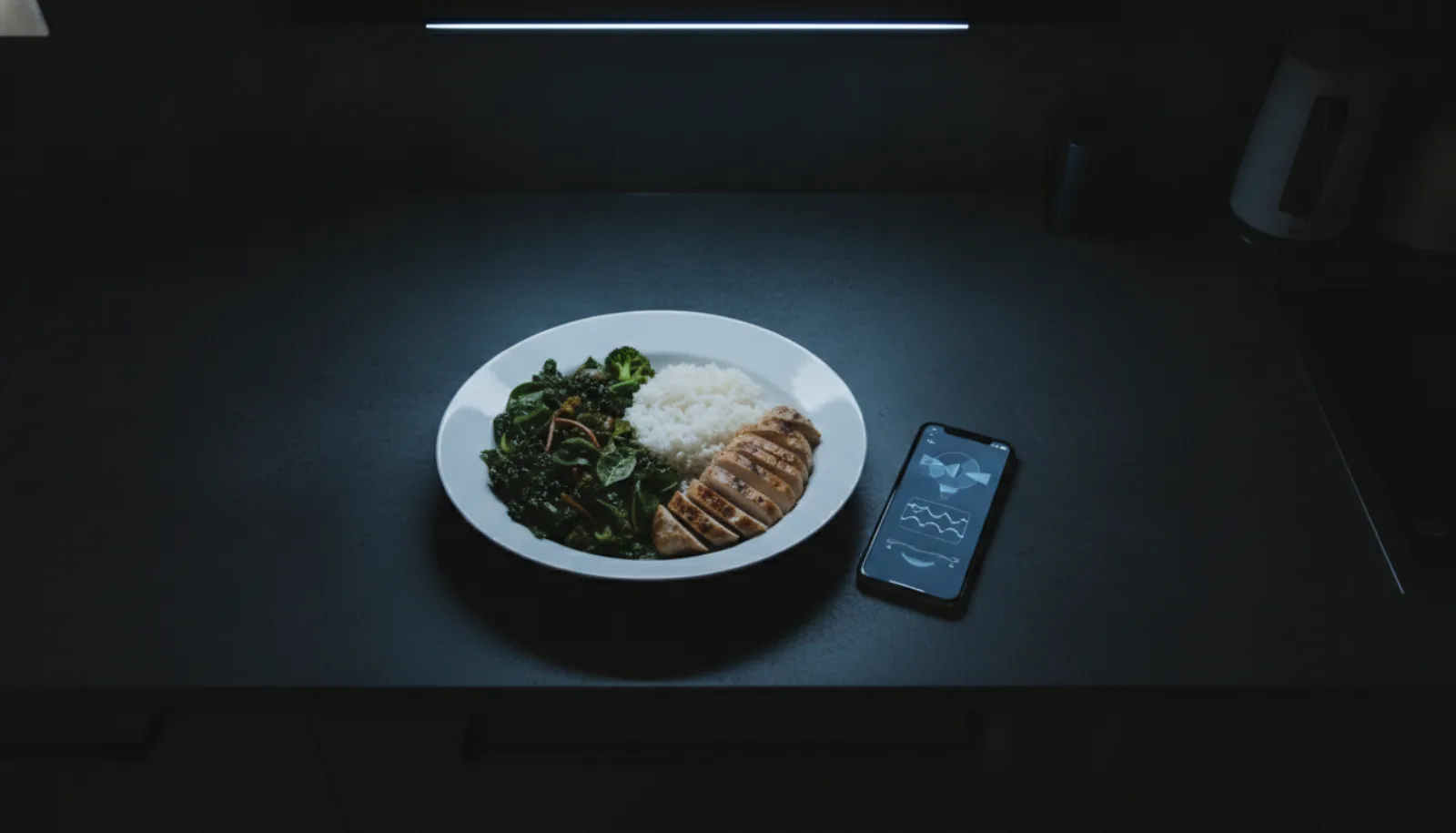
To log food by voice, hold the mic and say the whole meal in one sentence. “3 eggs, 55 g bread, 10 g butter” is logged as spoken. What comes back is a list of ingredients and quantities to review before it saves, which is how Cronometer’s voice log works. Most of the work is in the sentence, not the app. Name the portion instead of leaving it to an average, say how the food was cooked, and correct the one line that comes back wrong instead of recording the meal again.
Say the item, the portion, and how it was cooked
A spoken entry has three slots: the item, the portion, and how it was cooked. Leave one out and the app fills it with an average.
Copy the shape of GreekBody’s own example, “3 eggs, 55 g bread, 10 g butter”. Number, unit, item, three times, one breath. No search box, no scrolling forty results for “bread”.
Portion is where most men go vague. “Some rice” hands the guess to the app. “A cup of rice” is your guess, which is closer to what you actually ate. A weight in grams is better again. The pages that rank for this question call this natural portion language, and they list it beside one-shot meal parsing and brand recognition as the things a voice tracker has to get right.
Preparation is the word men drop first. Chicken and fried chicken are the same cut and a different plate, and the fat in the pan is the part the app cannot see. Say the cooking method and say what you cooked it in. The example names butter and gives its weight for that reason.
Hold the mic, say the sentence, let go. In GreekBody that hold-to-talk mic sits on the coach’s composer: say breakfast to Achilles and he logs it, so logging does not start with finding the food screen.
The words that matter most are the ones phone dictation gets wrong: the number, the unit, the brand. GreekBody started on the iPhone’s built-in dictation and moved off it for that reason. The audio now goes to a transcription model, and the consent screen names who runs it before the first word is sent.
Log the whole meal in one sentence
One sentence, several items. “3 eggs, 55 g bread, 10 g butter” is one thing you say and it is logged. The checklist the competing pages publish calls this one-shot meal parsing. That is what separates a voice feature from a microphone bolted onto a search box.
Item-by-item dictation is the trap. Speak, wait, confirm, speak, wait, confirm, and a four-item dinner takes longer than typing it would have. If that is what you are doing, the app is transcribing you, it is not parsing you.
The dinner you eat four nights a week does not need a sentence at all. In GreekBody the meal it is time for already shows what you usually eat then, and one tap logs it again; a whole past meal logs again with a swipe. Saved foods and recipes cover the rest. Speak the meals that change. Tap the ones that repeat. Most men have five or six meals on rotation and a handful of one-offs, and only the one-offs are worth talking to. The rotation is where a protein target for fat loss is hit or missed, so the templates are worth building once. Repeat meals are also the easiest case for skipping a scale altogether: track calories without weighing food leans on that same repetition alongside hand portions and household measures.
Where voice wins, and where scanning still wins
Voice is for food with no barcode: the cooked meal, the restaurant plate, the four things you put in a pan. A wrapper already carries an exact label, so scanning it beats describing it.
| Situation | Fastest input |
|---|---|
| A cooked meal with several items | Voice |
| A packaged item with a barcode | Scan |
| A meal you eat every week | Saved food or template |
| A loud room, or one where you cannot talk | Typing |
The mainstream trackers now do this too. Google’s AI Overview for this question answers with MyFitnessPal and Cronometer. The AI Overview for the sibling query records that MyFitnessPal’s voice log requires a premium subscription. The rest of that first page is app product pages and app store listings. Voice logging also turns up inside broader tools, which is where the AI coach apps for men sit.
Noise is the real limit. Speech recognition through background noise is on the competing checklist for a reason. On a gym floor with music running, typing four characters into a saved food is the faster move, and knowing that is part of using the mic well.
When the parse is wrong, edit the entry
A voice log does not go straight into the diary. It comes back as a list of items and quantities that you check before it is saved, which is exactly how Cronometer’s flow works. That review list is the point of the whole feature. It is where “55 g bread” caught as “a slice of bread” gets corrected while you still remember the loaf.
Fix the line, not the meal. If the bread came back wrong, edit the bread and leave the eggs alone. Re-recording the whole sentence tends to reproduce the same mistake, because the words that confused the parser are the words you are about to say again. Editing without re-recording is on the competing checklist too.
The same rule binds the coach. GreekBody’s Achilles corrects a wrong row with an edit, never by deleting the meal and logging it again; that loop, log, delete, log, is how a model second-guesses itself into a mess, and it is refused outright. A row you changed yourself while it was answering is left as you set it. In the meal sheet, plus and minus move the number at once and the save lands a second after your last tap, so a correction never waits on the signal.
Correct two entries by hand in the first week and you will hear how the parser takes your sentences, which is what stops the third mistake.
What it looks like three months in
Three months in, accuracy is not what decides whether you are still logging. Friction is. A ten-second sentence still happens on a Tuesday when you are tired and late; opening a search box, typing “chicken”, and picking the right row out of forty does not.
Which is why where the mic lives matters more than how clever it is. GreekBody puts hold-to-talk on the coach’s composer, where one sentence to Achilles logs the meal or the set, and the product brief’s line for it is blunt: “We never want them to type.” The mic is free forever, never gated and never metered.
No adherence statistic goes here, because none was measured. The case for speaking is mechanical, and a week of your own logs settles it better than a borrowed number would.
Voice logging is a sentence, not a feature. Three slots, one breath, then a glance at the list before it saves. Talk through the meals that vary, tap the ones on rotation, scan whatever comes in a wrapper, and type when the room is too loud for any of it. The apps differ in where the mic lives and what it costs. GreekBody keeps it on the coach’s composer, free and never metered. Try it for a week of real dinners and see whether you are still logging at the end of it.
Frequently asked questions
Can I log a whole day of meals in one voice command?
A meal is the practical unit. One-shot meal parsing is the first requirement on the checklist competing pages publish for a voice tracker. A voice log comes back as ingredients and quantities for review before it saves, so a longer command means a longer list to check.
How is this different from speaking into the search box?
Dictation drops words into a search field and leaves you picking rows out of a results list. A voice logger takes the sentence and lists the ingredients and quantities for your review before saving them, the way Cronometer's voice flow does. On the competing checklist that parse sits above speech recognition itself, at number one.
Does voice food logging cost extra?
In MyFitnessPal it does: Google's AI Overview records that its voice log requires a premium subscription. In GreekBody the hold-to-talk mic is free forever, never gated and never metered, alongside unlimited food and workout logging.
Can I photograph the plate instead of speaking?
In GreekBody the photo path is a Pro feature, separate from the free mic. A vision model sizes each item and it is logged at the middle of its range, marked as an estimate; on logged photos the gram error runs at 25 to 35 percent. Speaking stays the faster route, and the more exact one, for a meal you can describe in one sentence with the grams in it.